

Quick Summary: Clinical Fear of Heights Hypnotherapy resolves acrophobia by resetting how your autonomic nervous system reacts to high places. Instead of pushing you out onto terrifying ledges, we use targeted trance work and progressive Desensitization to replace panic reflexes with automatic physical calm.
Standing on a third-floor balcony should not trigger cold sweats, nausea, or a racing pulse. Yet for millions living with Acrophobia (Wikipedia), mere vertical distance triggers an immediate surge of survival panic. Your rational brain knows the railing is solid steel bolted into concrete. Your survival brain screams that you’re about to plummet.
Logic can’t win that argument.
Phobic responses aren’t logical thoughts; they’re conditioned neurological alarms. Traditional exposure therapy tries to wear this alarm down by dragging people directly into high places. That process often feels unbearable, which is why so many people quit before finding relief. Clinical hypnosis takes a gentler, far more effective approach. We work directly with the subconscious instincts that control your heart rate and muscle tension, stripping the terror out of height cues without the misery of white-knuckle exposure.
Why Traditional Exposure Fails for Severe Height Anxiety
Standard exposure therapy pushes you toward open ledges, glass elevators, or suspension bridges until your nervous system exhausts itself. For mild discomfort, that approach can work. But for the severe phobic reactions classified under Phobias – National Institute of Mental Health (NIMH), forced confrontation backfires fast. Flooding frequently re-traumatizes the nervous system instead of desensitizing it.
The moment sheer panic hits, your amygdala shuts down your prefrontal cortex. Adrenaline floods your bloodstream. Instead of learning that the balcony is safe, your subconscious records a memory of raw, survival-level dread. That strengthens the phobic loop, leaving you even more sensitive to vertical drops than you were before.
Exposure Therapy vs. Fear of Heights Hypnotherapy
| Metric | In-Vivo Exposure Therapy | Desensitization Hypnotherapy |
|---|---|---|
| Distress Level | High; requires confronting real triggers directly. | Minimal; guided in a deeply relaxed hypnotic trance. |
| Dropout Rates | Moderate to high due to anticipatory anxiety. | Low; clients feel safe, grounded, and in control. |
| Subconscious Reprogramming | Indirect; relies purely on cognitive behavioral repetition. | Direct; works at the root memory and instinctual level. |
| Physiological State | Sympathetic arousal (fight-or-flight). | Parasympathetic dominance (rest-and-digest). |
How Does Subconscious Reprogramming Dissolve Acrophobia?
Hypnotherapy breaks the conditioned connection between vertical visual cues and involuntary sympathetic arousal. Your nervous system cannot tell the difference between a vividly imagined scene in deep trance and an actual physical event. Neuroimaging confirms that hypnotic visualization activates the same sensory and motor regions as real-world exposure.
We use this exact neurological quirk to your advantage.
While your body sits anchored in parasympathetic rest—heart rate slow, breath deep, shoulders dropped—we introduce height cues in measured doses. Because the panic response never fires, your brain reclassifies Heights as neutral rather than life-threatening.
The 5-Phase Fear of Heights Hypnotherapy Desensitization Protocol
Real clinical hypnosis is methodical, not theatrical. We don’t snap our fingers and tell you to forget your fears. At HolisticHypno Healing, we use a structured 5-phase Protocol that systematically rebuilds autonomic tolerance.
Phase 1: Diagnostic Assessment and Trigger Mapping
We start by breaking down your specific panic patterns. Acrophobia isn’t one-size-fits-all. One person freezes on a six-foot stepladder; someone else handles ladders fine but panics behind floor-to-ceiling glass on the twentieth floor.
We quantify your baseline using the Subjective Units of Distress Scale (SUDS) from 0 to 10. We track your physical tells: tingling fingers, chest constriction, or the phantom sensation that the floor is tilting beneath you. Mapping precise physical cues lets us confirm neurological relief as it happens.
Phase 2: Somatosensory Induction and Parasympathetic Anchoring
We establish deep physical ease before touching any imagery of Heights. Using ocular fatigue, progressive muscle relaxation, and steady vocal pacing, we shift your brainwave state down into alpha and theta rhythms.
Once your body settles completely, we set a physical anchor. You firmly press your thumb and middle finger together while soaking in that intense somatic calm. This anchor acts as an immediate physical handbrake whenever tension tries to surface.
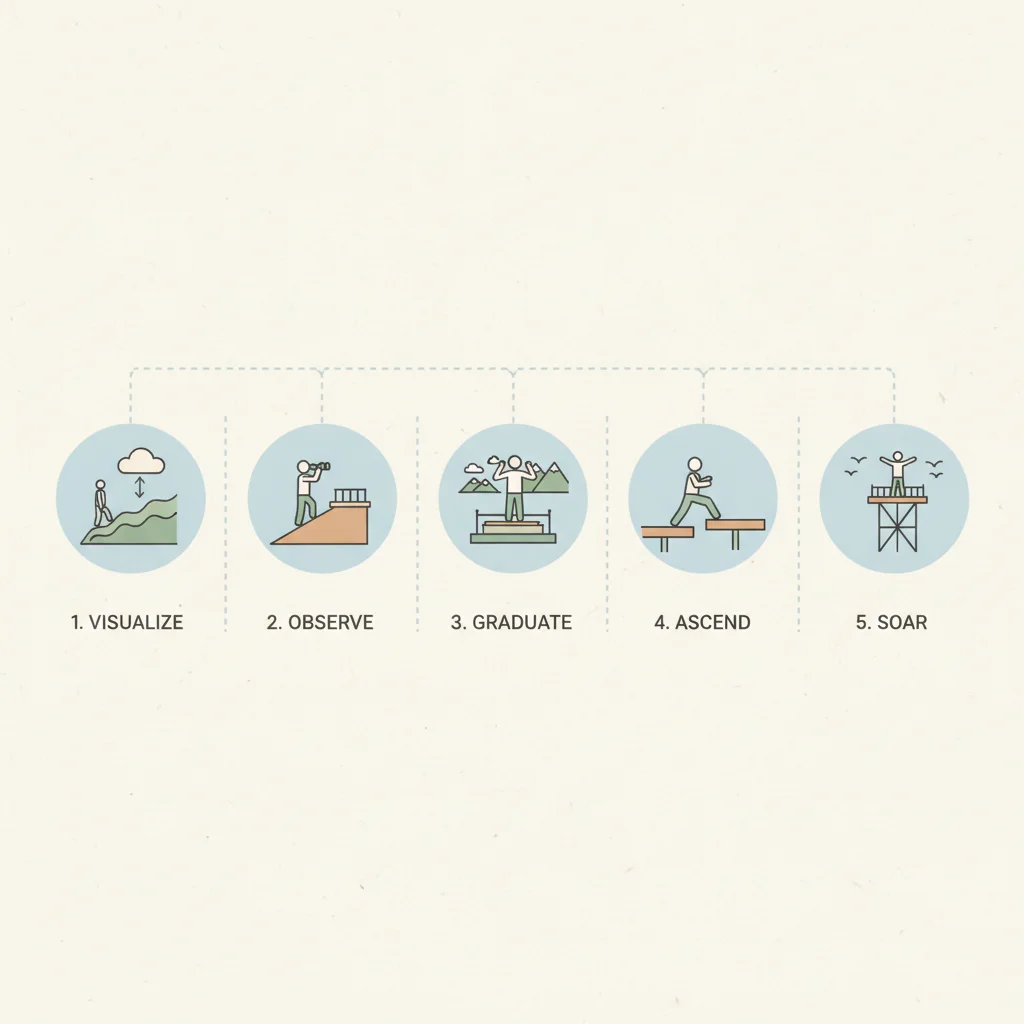
Phase 3: Progressive Height Visualization (The Dissociation Ladder)
Here we begin Desensitization using double dissociation. You imagine sitting comfortably in a private cinema, watching a black-and-white film of yourself standing on a secure, high terrace. You are watching yourself watch the scene.
This dual perspective creates immediate psychological safety. Your muscles stay slack while your eyes process the visual cues. As you adjust, we add color to the film, bring your perspective forward, and Step gradually up your SUDS ladder:
- Step 1: Looking up at an overpass from ground level (SUDS target: 0-1).
- Step 2: Looking through a closed second-story window (SUDS target: 0-1).
- Step 3: Stepping onto a solid fifth-floor balcony (SUDS target: 1-2).
- Step 4: Standing comfortably by a transparent rooftop barrier (SUDS target: 1-2).
If your SUDS score creeps past 3 at any point, we stop the film instantly. You press your anchor, reset your nervous system, and only continue once your pulse stabilizes.
Phase 4: Cognitive Reframe and Subconscious Anchoring
Severe height anxiety almost always feeds on intrusive thoughts—the false feeling of being pulled downward, or the irrational Fear that the glass will spontaneously shatter. In Phase 4, we replace these catastrophizing thoughts while your mind is completely receptive.
We install post-hypnotic patterns that turn high vantage points into places of perspective, clarity, and safety. Your brain stops registering height as a fall in progress and starts seeing it for what it actually is: solid, stable ground with an open view.
Phase 5: Post-Session Real-World Reinforcement
The work doesn’t stop in the chair. We give you targeted self-hypnosis audios to reinforce these calm baseline responses at home. You listen daily for two weeks.
From there, you run low-stakes real-world tests: crossing a pedestrian footbridge, driving an overpass, or stepping out on a friend’s balcony. You move at a manageable pace without panic. To learn more about our broader practice, explore our Hypnotherapy Services Overview.
Client Milestones: Tracking Your Progress Away From Phobic Fear
Acrophobia recovery rarely means waking up wanting to skydive. True progress shows up as quiet, effortless neutrality in spots that used to terrify you.
- Milestone 1: Zero Anticipatory Dread. Someone invites you to a rooftop dinner, and you say yes without losing sleep or dreading the date all week.
- Milestone 2: Calm Physical Baseline. When entering an express elevator or navigating a winding hill, your breath stays steady and your shoulders remain down.
- Milestone 3: Releasing the White-Knuckle Grip. Instead of fixing your eyes to the floor or grabbing the nearest wall, you look out toward the horizon naturally.
- Milestone 4: Genuine Presence. You lean against a secure railing, admire the skyline, and actually enjoy the view instead of calculating the drop.
Safety Considerations and When to Pause the Protocol
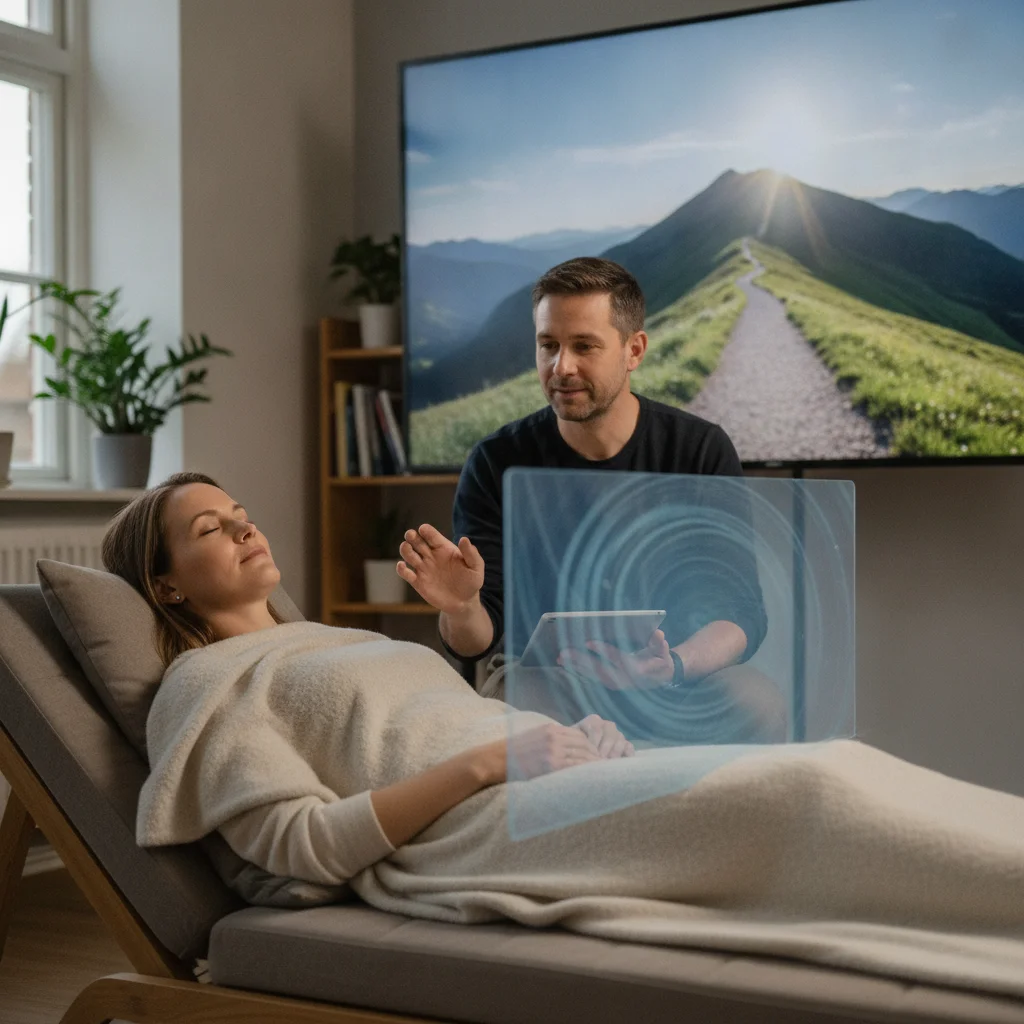
Hypnotherapy is gentle and non-invasive, but professional work demands clear boundaries. We track your physical signals throughout every session. If a client shows rapid shallow breathing, involuntary tremors, or sudden emotional distress, we hit pause right away.
Desensitization works through consistent neurological safety, not by white-knuckling through distress. We ground you immediately through tactile focus—feeling the chair beneath you, planting your feet firmly on the floor, and evening out your breath. Hypnosis is never an endurance test.
Frequently Asked Questions
Can Fear of Heights Hypnotherapy cure acrophobia permanently?
Yes, Hypnotherapy creates lasting changes by retraining the subconscious mind’s learned panic response to elevation, pairing imagined height triggers with physical relaxation instead of Fear.
How many hypnosis sessions are typically required for acrophobia?
Most clients see significant shifts within three to six structured sessions using progressive Desensitization, somatic anchors, and targeted subconscious reframing.
How does Desensitization hypnosis differ from standard exposure therapy?
In-vivo exposure forces direct physical confrontation with Heights, which often triggers severe panic. Desensitization hypnosis simulates exposure in a safe hypnotic trance while keeping the body deeply relaxed.
Can someone practice height Desensitization hypnosis at home?
Yes. Once an experienced hypnotherapist establishes a somatic relaxation anchor during clinical sessions, you can fire that anchor and use audio reinforcement independently.
Reclaim Your Freedom at Any Elevation
You don’t need to spend your life dodging scenic overlooks, balconies, highway bridges, or glass elevators. Retrain your nervous system to stay steady, grounded, and completely at ease wherever you stand.