


Quick Answer: Rapid-Response Hypnotherapy calms a sudden Panic Attack by interrupting the brain’s acute fight-or-flight cycle and guiding the autonomic nervous system into parasympathetic recovery. Instead of forcing rational thoughts through an adrenaline surge, this targeted trance protocol uses sensory somatic cues and subconscious breathing patterns to quiet severe Panic symptoms in under five Minutes.
Your chest tightens without warning. The room suddenly feels distant, your palms turn cold and clammy, and your pulse hammers against your ribs. Panic strikes like an ambush, producing physical sensations so violent they feel impossible to control. As detailed in the National Institute of Mental Health – Panic Disorder overview, Panic episodes bring sudden waves of intense fear alongside heart palpitations, trembling, and dizziness, even when you aren’t in any actual danger.
Standard advice tells you to challenge your catastrophic thoughts or repeat positive mantras. When adrenaline floods your system, that advice falls flat.
The reason is simple: your prefrontal cortex goes dark the second your amygdala slams the Panic button. You can’t talk your way out of a primal survival reflex with logic alone. Rapid-Response Hypnotherapy bypasses panicked internal debate by speaking directly to the autonomic nervous system through somatic trance states.
How does Rapid-Response Hypnotherapy halt acute anxiety?
Panic attacks are physiological chain reactions driven by subconscious threat alarms. The moment your brain misinterprets a sensation, it dumps epinephrine and cortisol into your bloodstream. Your breathing turns shallow and Rapid, tipping your blood chemistry into respiratory alkalosis. That chemical shift produces dizziness and tingling, which alarms your brain even further. You end up trapped in an escalating loop.
Hypnosis breaks this circuit by turning your attention inward while shifting your physical baseline. As outlined in the Wikipedia – Hypnosis overview, trance involves focused attention, reduced peripheral awareness, and heightened responsiveness to direct suggestion. During an active Attack, you don’t have time for a slow, reflective meditation. You need an immediate somatic emergency brake.
Real-time anxiety hypnosis resets your nervous system from the outside in. By locking your gaze upward and matching an extended exhalation with a physical touch cue, you directly stimulate the vagus nerve. Your heart rate slows down. Your constricted blood vessels open back up. Your brain finally gets the message that you’re safe. Targeted hypnotic suggestions restore autonomic balance faster than passive waiting because they redirect physical responses at the subconscious level.
Three Rapid-Response Hypnotherapy techniques to stop Panic in Minutes
You don’t have to white-knuckle your way through an episode. These three techniques deliver Rapid relief by pairing physiological resets with focused subconscious conditioning. Run through them during Calm moments so your body executes them on reflex when Panic hits.
1. The Hypnotic Gaze and 4-7-8 Breath Induction
This protocol uses eye strain to trigger a Rapid theta-wave shift while restoring your blood’s carbon dioxide balance.
- Lock your gaze: Look up toward the ceiling without tilting your chin. Pick a single point—a ceiling corner, a shadow, or a speck of paint—and keep your eyes glued to it.
- Inhale for 4 seconds: Draw air deep into your belly through your nose while keeping your upward gaze locked.
- Hold for 7 seconds: Keep the air in your lungs without clenching your throat. Feel the heavy, tired sensation building behind your eyelids.
- Exhale for 8 seconds: Blow the air out through softly parted lips with an audible whoosh. Let your eyelids drop shut as the breath leaves your body.
- Repeat three times: With every long breath out, silently give your body one command: Release down completely.
2. Sensory Grounding Visualization
Panic brings severe tunnel vision and terrifying feelings of detachment. This protocol snaps you out of depersonalization by forcing your brain to process neutral physical data across multiple senses.
Close your eyes. Imagine a single drop of cool, heavy water resting right on the crown of your head. Follow the cool weight as it flows over your scalp, unclenching your temples and releasing your jaw. Track it down past your collarbones, through your shoulders, and down to your fingertips.
The instant that imagined cool sensation reaches your hands, focus on what your skin is physically touching right now. Feel the coarse denim of your jeans, the cold grain of a desk, or the texture of your steering wheel. Keep your full attention locked on that physical contact for sixty seconds.
3. The Kinesthetic Anchor-Reset Script
An anchor pairs an intentional physical touch with a distinct nervous system state. Once you install it through practice, pressing the anchor brings on the Calm Response automatically.
Press the pad of your thumb hard against your index finger on your dominant hand. Take one steady breath in. As you exhale, say this phrase in your mind with quiet certainty:
Keep your fingers pressed together for five seconds while you drop your shoulders away from your ears. Release your grip, breathe naturally, and run through the sequence twice more. Conditioning your nervous system with physical anchors turns Rapid Panic coping into an instinctual motor memory rather than a mental struggle.
How Rapid Hypnotherapy compares to traditional coping methods
Most coping strategies ask you to think your way through an episode. That demands heavy cognitive control at the exact moment your brain can’t deliver it. Here is how Rapid Hypnotherapy stacks up against common coping tools during an active surge.
| Method | Mechanism | Cognitive Effort Needed | Average Onset of Relief |
|---|---|---|---|
| Cognitive Reframing | Logical challenge to catastrophic thoughts | High (difficult during adrenaline spikes) | 10 to 20 Minutes |
| Basic Box Breathing | Voluntary regulation of carbon dioxide | Moderate (requires steady count) | 5 to 10 Minutes |
| Rapid-Response Hypnotherapy | Subconscious cues, eye fixation, kinesthetic anchors | Low (relies on conditioned somatic Response) | 2 to 4 Minutes |
Cognitive exercises do great work over months of therapy, but they don’t stop a racing heart in sixty seconds. While cognitive therapy addresses the root causes of anxiety over time, Rapid trance work functions as an emergency brake to regain physical control right away.
How do you set up an environment for quick Panic coping?
Your surroundings send continuous signals to your subconscious mind. Adjusting a few sensory details can cut down the time it takes your body to stand down.
Cut harsh light first. Overhead fluorescents trigger vigilance circuits and make sensory overload worse. Dim the room, switch on a low desk lamp, or look away from monitors. If you can’t touch the light switches, just close your eyes to shut down roughly eighty percent of your incoming visual load.
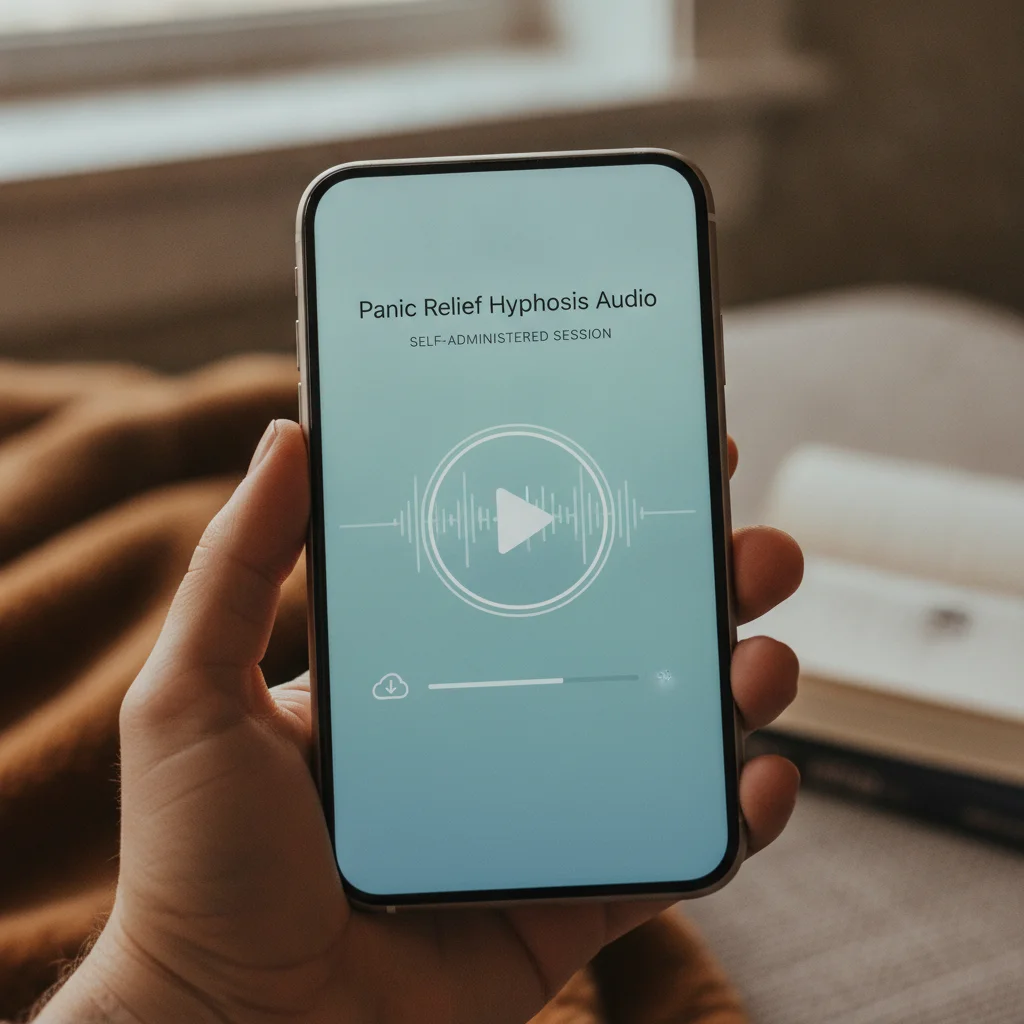
Next, give your ears a steady rhythm. Complete silence often makes a pounding pulse sound louder, while sudden noise keeps your nerves on edge. Put on headphones with low ambient noise, binaural beats, or a short guided audio track. Storing a brief hypnotic recording on your phone gives your brain an outside tempo to match when internal thoughts feel chaotic.
Finally, reset your body position. Panic curls you forward into a guarded crouch with hunched shoulders and shallow breathing. Sit upright with your feet planted flat on the floor and lay your hands open on your thighs. That posture sends an unmistakable message to your brainstem: there is no physical threat to run from.
Downloadable Audio Script Protocol
Keep a 3-minute Rapid-Response Hypnotherapy audio script accessible on your phone’s lock screen. When adrenaline strikes, do not try to remember complex sequences. Plug in your earphones, press play, follow the guided eye fixation, and let the voice lead your breathing down from Panic to stability.
A calibrated environment removes sensory friction, allowing Rapid-Response Hypnotherapy techniques to take hold within seconds.
Is real-time anxiety hypnosis safe during an episode?

People often hesitate around hypnosis because they worry about losing control. If an Attack already makes you feel detached from reality, the idea of entering a trance sounds intimidating. Popular culture hasn’t helped, painting trance as stage sleep or amnesia.
Therapeutic hypnosis isn’t sleep. It is focused, directed attention. You hear everything around you, you choose what to do, and you can open your eyes and walk away at any second.
Real-time anxiety hypnosis simply taps into your brain’s natural capacity to alter physical sensations through directed focus. It gives you a reliable way to lower your heart rate and release tight muscles. Hypnosis gives you an active, focused way to down-regulate your nervous system while keeping you in complete control the entire time. Keep in mind that if you navigate complex dissociative conditions or psychosis, you should work alongside a licensed medical provider before using trance protocols.
Frequently Asked Questions About Rapid-Response Hypnotherapy
What is Rapid-Response Hypnotherapy?
It is an acute intervention that combines focused trance induction, physiological breathing patterns, and somatic anchors to deactivate the nervous system’s fight-or-flight Response within Minutes.
Can you do self-hypnosis while having a Panic Attack?
Yes, using short sensory cues and eye-fixation techniques rather than complex visual scripts allows you to engage self-hypnosis even when adrenaline is high.
How does Hypnotherapy differ from standard deep breathing?
While deep breathing alters oxygen levels, Hypnotherapy pairs physiological shifts with subconscious suggestion and kinesthetic anchors, creating an immediate conditioned relaxation Response.
Is Rapid-Response Hypnotherapy safe for everyone?
It is safe for most people dealing with stress and Panic attacks, though individuals with dissociative disorders or psychosis should consult a healthcare provider before practicing trance work.
Take Control of Panic Attacks with Personalized Care
A Panic Attack makes you feel trapped in a body you can’t steer. While on-the-spot self-hypnosis gives you an emergency brake, resolving the deeper subconscious triggers stops the Panic from starting in the first place. Explore our Hypnotherapy services for anxiety and Panic attacks to understand how structured clinical sessions unseat old fear patterns and rebuild your baseline resilience.
You don’t have to spend your days dreading the next surge. Schedule your free 30‑minute consultation with Merve today to learn personalized Rapid-Response Hypnotherapy protocols tailored to your unique triggers and lifestyle.