


Most diets fail because they ignore the brain. Hypnosis Weight Loss Science reveals that shifting your subconscious programming alters cortisol and leptin levels, making appetite control a physiological reality rather than a willpower test. At HolisticHypno Healing, we use this biological mechanism to help you stop fighting your body and start working with it.
The Biological Engine: Why Your Brain Controls Your Scale: Hypnosis Weight Loss Science Explained
Diet culture tells you Weight Loss is a math equation. Calories in, calories out. That’s a lie that hurts. Your body isn’t a calculator; it’s a survival machine governed by neuroendocrine signals. When you’re stressed, tired, or emotionally triggered, your endocrine system overrides your logical intent to eat less.
This is where the Wikipedia entry on leptin and its role in appetite control becomes relevant. Leptin isn’t just a “satiety hormone.” It’s the signal that tells your brain to stop eating. However, leptin resistance, often driven by chronic stress and inflammation, blinds you to this signal. You feel hungry because your brain is screaming that it is starving, even when your tank is full.
Hypnotherapy intervenes directly in this loop. It’s not about “suggestion” in a magical sense. It’s about re-conditioning the basal ganglia, the part of the brain responsible for habits and automatic behaviors. When we reduce the sympathetic nervous system’s overdrive, we allow the parasympathetic system to reset. This shift has measurable effects on hormone production.
How Hypnosis Affects Key Appetite Hormones
The Hormonal Shift
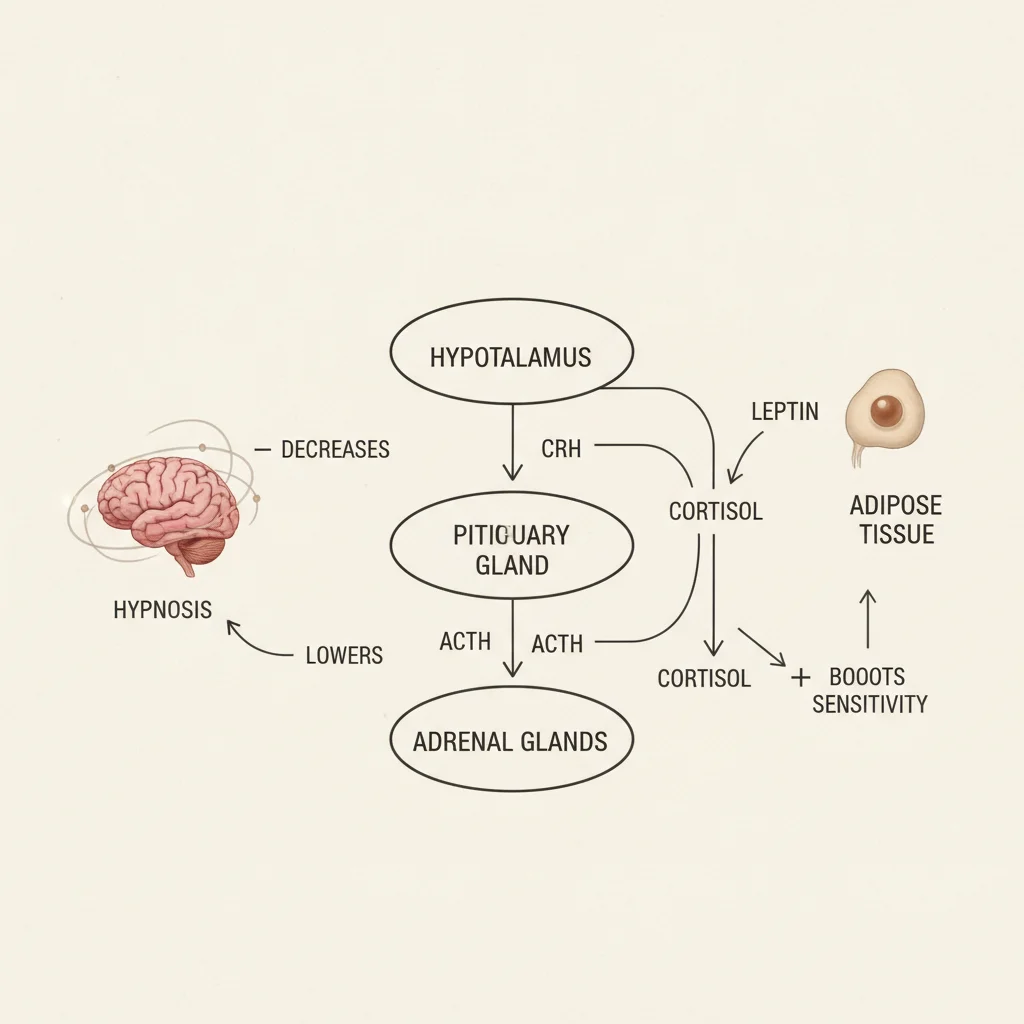
Research indicates that Hypnosis can modulate the HPA (hypothalamic-pituitary-adrenal) axis, directly lowering cortisol. Lower cortisol reduces the body’s tendency to store visceral fat and decreases the drive for high-sugar, high-fat foods that spike insulin further.
A NIH study on Hypnosis and Weight-Loss hormone regulation provides a foundation for understanding this physical connection. While individual responses vary, the mechanism is consistent: relaxation reduces stress hormones, which in turn stabilizes the appetite-regulating hormones ghrelin and leptin.
Here’s the practical takeaway. You can’t out-diet a high-cortex, high-cortisol environment. Hypnotherapy for Weight Loss works because it addresses the root neurological cause of overeating, not just the behavioral symptom.
How Does Holistic Hypno Healing’s 3-Step Program Work?
We don’t hand you a generic audio track and wish you luck. Our approach is a structured clinical intervention designed to rewire your relationship with food. Here’s exactly how the process unfolds, step by step, so you know what to expect.
- Step 1: The Deep State Assessment
We begin with a 30-minute consultation. We map your “food triggers.” When do you eat? Not what, but when. Are you eating when stressed? Bored? Lonely? We identify the specific neural patterns driving your behavior. - Step 2: The Subconscious Rewrite
In the first two sessions, we enter a state of deep relaxation. This is where the actual Hypnosis Weight Loss Science bites. We introduce new suggestions that replace “I need this food to cope” with “I am full and satisfied.” This sounds simple. It’s incredibly hard to do consciously. The subconscious accepts it easily. - Step 3: The Physiological Reset
We focus on the cortisol feedback loop. By teaching your nervous system how to exit fight-or-flight mode without food, we reduce the physiological demand for comfort eating. This is where appetite control hypnotherapy becomes visible in your bloodwork and on the scale.
The Cortisol Connection: Why Stress Dieting Fails
Many people try to lose Weight during their busiest, most stressful months. They cut calories strictly, skip sleep, and wonder why they are gaining Weight. This is cortisol at work. High cortisol degrades muscle mass, slows metabolism, and increases cravings for processed foods.
Cortisol reduction Hypnosis is not a luxury; it is a necessity for sustainable Loss. If you’re in a state of chronic stress, your body holds onto fat as a reserve. Hypnotherapy helps you break this cycle by activating the vagus nerve, promoting a state of rest and digest. You start eating because you’re hungry, not because you’re anxious.
What Mindset Shifts Does Hypnosis Induce?
The biological changes are supported by cognitive Shifts. When you stop fighting your subconscious, your relationship with food transforms. Here are the three core Mindset Shifts we observe in our clients.
| Mindset Shift | The Result |
|---|---|
| From Deprived to Satisfied | You stop viewing food as the enemy. Cravings lose their urgency. |
| From Reactive to Intuitive | You learn to distinguish between physical hunger and emotional eating. |
| From All-or-Nothing to Consistent | One “bad” meal doesn’t ruin your progress. You build resilience. |
This shift is vital because willpower is a finite resource. Hypnosis replaces the need for constant willpower with automatic, healthy defaults. You don’t have to “decide” to eat a salad every day. The desire for the salad simply becomes stronger than the desire for the cookie.
Who Is This For? A Client Snapshot
Let’s look at a hypothetical scenario that reflects the reality of many of our clients. Imagine Sarah, 34, a project manager. She is intelligent, driven, and has tried every diet under the sun. Keto, Intermittent Fasting, Plant-Based. For three weeks, it works. Then the stress of a big deadline hits. She eats stress food for three days. The Weight comes back, plus two pounds. She feels like a failure.
Sarah’s problem was not a lack of knowledge. She knew exactly what to eat. Her problem was a dysregulated nervous system. Her body was biologically primed for storage because it felt unsafe.
After four sessions of Weight Loss Hypnotherapy Services, Sarah reported a 6% reduction in her resting heart rate. More importantly, the “midnight snack” habit disappeared. Not because she forbade it, but because the urge simply faded. Her Weight Loss hormone Hypnosis journey hadn’t just changed her diet; it had changed her baseline stress response.
This is the difference between a diet and a transformation. A diet manages symptoms. Hypnotherapy treats the cause. If you’re tired of the yo-yo effect, you need to look at the Hormonal and neural drivers of your eating habits.
Does Hypnosis Alone Make You Lose Weight?
Here’s the honest answer: Hypnosis is a catalyst, not a magic pill. It removes the barriers to healthy behavior. It makes it easier to say no to the second slice of cake. It makes it easier to choose the walk over the couch. It lowers the cortisol that is blocking your metabolism.
However, you still need to move and nourish your body. Hypnosis optimizes the internal environment so that your external efforts actually stick. Think of it as clearing the brush before you build the house. The workout is the house. The Hypnosis is the land clearing.
Many clients find that leptin and Hypnosis interactions become more favorable after just two to three sessions. The sensitivity to leptin improves as overall stress drops. You feel fuller for longer. You crave less sugar. These are the concrete, tangible results that sustain long-term Weight Loss.
Frequently Asked Questions
How many sessions are needed for Weight Loss?
Most clients see significant Shifts in appetite and stress responses within 4 to 6 sessions. We recommend an initial phase of 3-4 weekly sessions to establish new neural pathways, followed by monthly maintenance sessions.
Will I lose Weight while sleeping?
Losing Weight during sleep is not a separate process, but the relaxed state achieved in hypnotherapy often carries over into your daily life, including rest. By lowering cortisol, you prevent the nightly hormone spikes that cause early morning hunger.
Is hypnotherapy for Weight Loss safe?
Yes, when practiced by a qualified professional. It is a non-invasive, drug-free modality. We screen for any contraindications during your consultation to ensure the process is safe and tailored to your specific needs.
How is this different from mindfulness?
Mindfulness is an active, conscious practice. Hypnosis induces a passive, receptive state. For deep, automatic habit change, the receptive state allows suggestions to bypass the critical factor of the conscious mind, making it more effective for ingrained behaviors like emotional eating.