


Quick answer: Mindful Eating Hypnotherapy helps you retrain automatic food cues by combining focused, moment-to-moment Eating practice with guided subconscious reprogramming. You get less impulsive snacking, clearer hunger/fullness awareness, and a practical path to long-term Weight control when you pair it with straightforward meal rules and brief daily self-hypnosis. Our protocol lays out measurable steps and short recordings you can actually use at home.
Everyday overeating and Mindful Eating Hypnotherapy: the real habit to fix
You’ve sat down for a meal and afterwards wondered where the time went. Eating while distracted wires the brain to link food with routines, stress, or emotion — and that wiring keeps replaying until someone interrupts it. Mindful Eating cuts that loop by shifting attention. Add Hypnotherapy and you change the cue-response pattern beneath conscious awareness.
Combining conscious attention with subconscious change reduces compulsive Eating more reliably than willpower alone.
What does the science say about Mindful Eating?
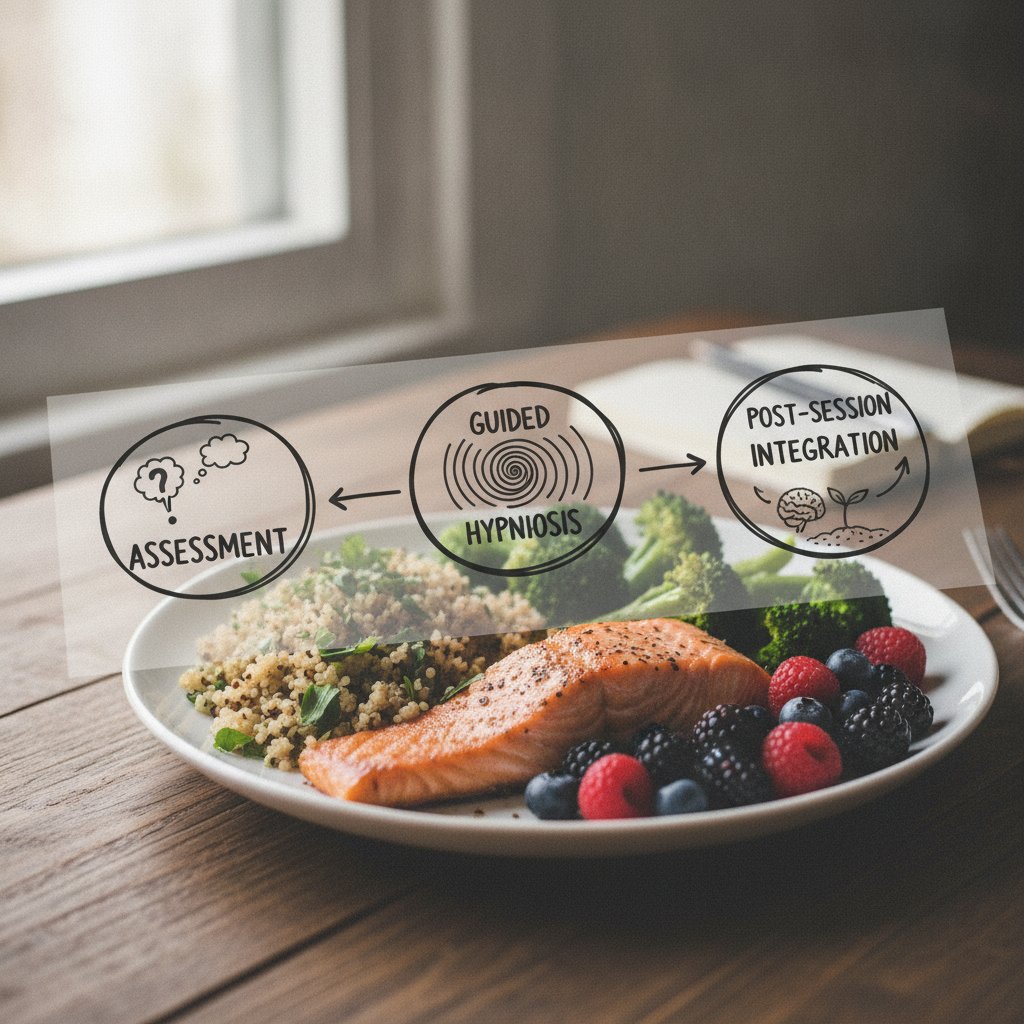
Structured Mindful Eating improves recognition of hunger and fullness and lowers emotional Eating triggers, supporting healthier choices over time. The NIH summarizes evidence that Mindful Eating increases meal awareness and helps some people make healthier choices; see Mindful Eating Benefits – NIH for a concise review.
Research shows that paying attention to taste, texture, and internal cues strengthens interoceptive signals. People often misread stress as hunger; we treat that misreading as a learned pattern, not a moral failing.
How does Hypnotherapy change subconscious food triggers?
Hypnotherapy accesses learned associations and replaces automatic reactions with practiced alternatives. In session we guide attention, imagery, and suggestibility to weaken the conditioned link between a trigger and an Eating response.
Hypnotherapy creates new, practiced responses that activate before an old, automatic urge does. Therapists use targeted language and memory reconsolidation techniques to reduce the strength of trigger-response pairs. That makes a pause or different action feel natural, not forced.
Can Hypnotherapy help intuitive Eating hypnosis for Weight loss?
Yes. We blend intuitive Eating principles with hypnotic reprogramming so hunger and fullness sensing becomes reliable again. The objective is steady habits that maintain Weight over years, not rapid, unsustainable loss.
Intuitive Eating hypnosis reframes food’s reward value and increases tolerance for internal signals. You stop Eating to soothe and start Eating to nourish. That shift cuts Weight cycling and reactive dieting behavior.
Common mistakes practitioners and clients make (and what we do instead)
- Relying on vague suggestions: Saying “eat mindfully” is weak. We give measurable cues and anchors.
- Ignoring timing: Waiting until a habit is fully entrenched reduces effectiveness. We pair early intervention with routine practice.
- Overloading listeners: Long, unfocused recordings fail. Short, specific self-hypnosis tracks work better.
We set clear, measurable thresholds and focus on reproducible practice rather than general motivation.
Step-by-step Hypnotherapy protocol for Mindful meals (exact, repeatable)
Below is a protocol we use for Weight-related Eating patterns. Use it as a repeatable process for clients or personal practice.
- Pre-meal pause (2 minutes): Sit. Close your eyes. Take six paced breaths (inhale 4s, exhale 6s). Check hunger on a 1-10 scale. Proceed to step 2 only if hunger ≥4/10.
- Anchor touch: Press thumb and middle finger together for 3 seconds to record an “eat mindfully” anchor. Repeat three times. This physical anchor is later triggered in hypnosis.
- Mindful bite routine: For each bite, chew 15-20 times. Put the utensil down between bites. Aim for a 20-30 minute total meal time for a full plate.
- Mid-meal check (after 50% of plate): Pause. Rate fullness on 1-10. If fullness ≥7/10, stop Eating and drink 150 ml water. Wait 15 minutes before deciding on a second helping.
- Self-hypnosis reinforcement (daily, 8 minutes): Listen to a scripted recording that replays the anchor, visualizes respectful Eating choices, and reinforces the 1-10 hunger/fullness signal. Recordings should use a calm 55-65 bpm speaking rhythm.
- Weekly session structure (practitioner): 60 minutes. 20 minutes intake and pattern mapping, 20 minutes guided hypnosis and anchor installation, 10 minutes homework scripting, 10 minutes review and measurement goals.
Decision rules: stop at 7/10 fullness; wait 15 minutes before additional food; use anchor only when pre-meal hunger ≥4/10.
Comparison: Mindful Eating vs. dieting vs. Mindful Eating Hypnotherapy

| Approach | Short-term effect | Reliance | Typical relapse risk |
|---|---|---|---|
| Rule-based dieting | Fast initial Weight loss | High willpower | High |
| Mindful Eating alone | Improved awareness | Moderate practice | Moderate |
| Mindful Eating Hypnotherapy | Sustained habit change | Practice + subconscious reconditioning | Lower (with maintenance) |
Practical trade-off: adding Hypnotherapy increases upfront time investment but reduces long-term relapse compared with rule-only dieting.
Real client snapshots from Holistic Hypno Healing (anonymized themes)
We report themes rather than exact claims. These snapshots reflect typical patterns we address at Holistic Hypno Healing.
- Evening grazer: client regained a reliable pause—using the anchor—before second helpings and replaced grazing with a 10-minute grounding routine.
- Emotional snacker: client learned to shift the reward response by pairing a 2-minute breath sequence with a low-calorie substitute, reducing impulsive snacking episodes.
- Mindless eater with fast consumption: client extended meal time to 25 minutes and regained accurate fullness cues, reducing the frequency of unplanned second portions.
These are anonymized themes observed in our practice; individual results vary and are affected by adherence and context.
How Emotional Freedom Technique (EFT) can complement Hypnotherapy
EFT offers a short, somatic tapping sequence that reduces acute stress-related urges. We sometimes integrate it as a 1-2 minute intervention before the pre-meal pause. See background at Emotional Freedom Technique (EFT) Wikipedia.
Combining EFT for acute urges with Hypnotherapy for longer-term reconditioning addresses immediate triggers and the underlying pattern simultaneously.
Practical tools you can use this week
- Record one self-hypnosis track, 8 minutes long, phrased in present tense: “I pause. I feel hunger. I eat with awareness.”
- Set your phone timer for 20 minutes per main meal to practice the Mindful bite routine.
- Keep a simple log: pre-meal hunger (1-10), mid-meal fullness (1-10), after-meal satisfaction (1-10). Review weekly.
Small, measurable practices beat vague intentions every time.
Frequently Asked Questions
Does Hypnotherapy actually change your biology?
Yes. Hypnotherapy influences neural pathways involved in conditioned responses and reward. It shifts the learned association between trigger and behavior, reducing automaticity.
How many sessions are typical for lasting change?
Many clients follow a 6-12 session plan with daily short recordings to consolidate changes. Frequency and length depend on habit depth and comorbid stress.
Is this the same as guided meditation?
No. Hypnotherapy uses targeted suggestion and memory reconsolidation techniques to alter conditioned responses. Guided meditation increases awareness but does not directly rewire conditioned Eating scripts.
Can I do this at home?
Yes. Daily 8-minute self-hypnosis recordings plus adherence to the meal protocol yield measurable improvement. Professional sessions speed up and stabilize that change.
Next step — book a free 30-minute consultation
If this approach fits your goals, we invite you to explore a tailored plan. Learn whether Mindful Eating Hypnotherapy matches your needs and get a practical first-week plan.
Holistic Hypno Healing Services Overview explains the services we offer. When you’re ready, Schedule Your Free Consultation for a 30-minute call to map next steps.