

Quick Answer — Executive Summary
Childhood Fear Hypnotherapy safely accesses early Fear Memories to reframe their emotional charge, reduce anxiety, and shift subconscious patterns that still run your responses. This Gentle approach pairs guided trance with targeted suggestion and integration work so adults can recover calm without reliving trauma. Book a free consult to see if it fits your needs.
Why early Fear Memories still run your life
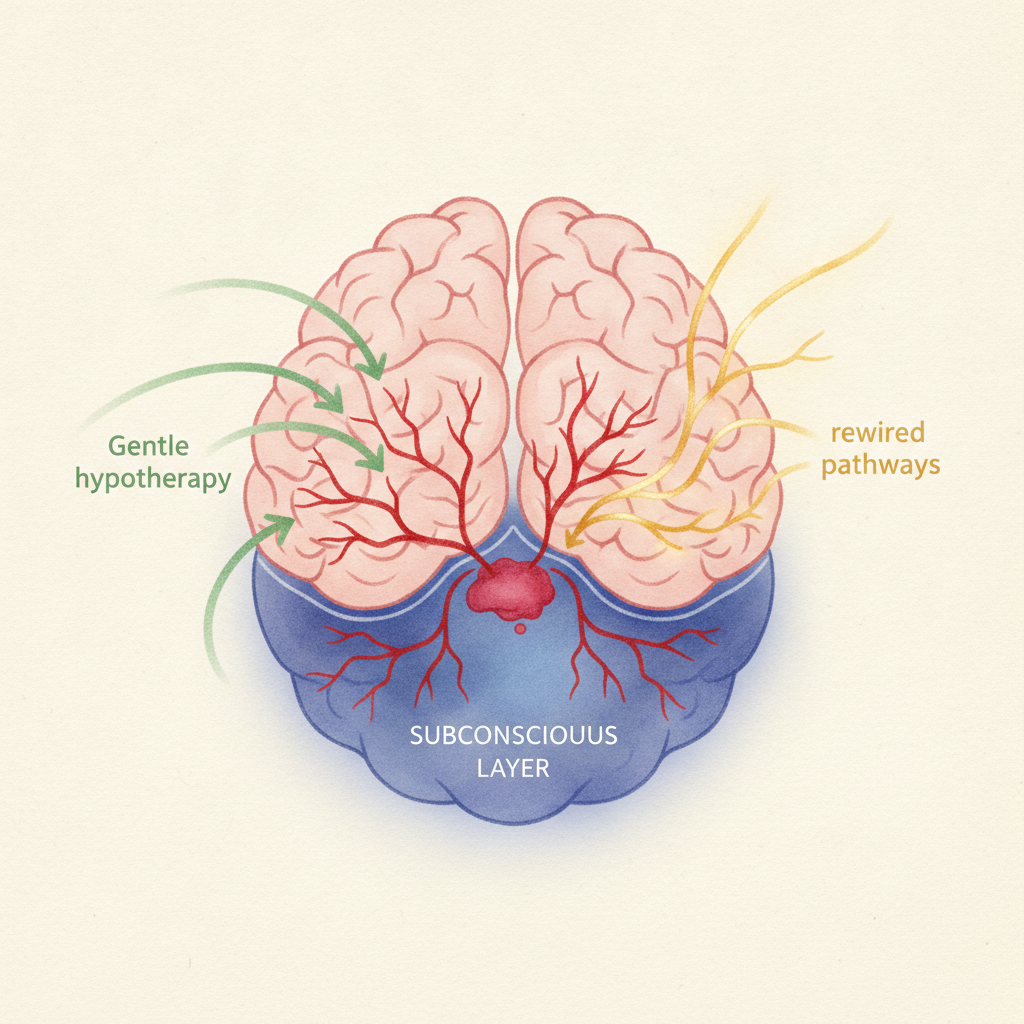
Children encode Fear in the wiring, not the narrative. A small event, like being startled at night, feeling left at bedtime, or a humiliating classroom incident, can imprint a high-arousal response onto a still-developing neural network. Those Memories often lack detail yet preserve the strong emotion, so later reminders trigger automatic anxiety, avoidance, or phobic responses.
That hidden emotional wiring often explains adult anxiety patterns that talk therapy alone doesn’t fully shift.
Clinical authorities document how early adversity alters stress-response systems; see Understanding Childhood Trauma – American Psychological Association for a concise review of trauma’s developmental effects.
How does Childhood Fear Hypnotherapy access early Fear Memories?
Gentle Hypnotherapy uses focused, safe relaxation to shift attention and access memory networks without forcing a full conscious replay. The method lowers physiological arousal so you can reprocess the feeling with corrective, present-moment suggestions.
In a light trance you stay fully aware and in control. We guide your attention to the core feeling rather than a detailed sensory replay. With arousal reduced, the amygdala’s alarm quiets and the cortex can reassess the memory, allowing a different association to form. This is direct subconscious Healing, reprogramming patterns rather than debating them.
Accessing the memory’s emotion, not re-living its worst moments, is how Gentle Hypnotherapy safely reframes early Fear.
What is the three-step breakthrough process used by Holistic Hypno Healing?
We use a clear three-step process: stabilize the nervous system, access and reframe the core Fear memory, then integrate the new response into daily life. Each step includes decision checkpoints so the work stays safe and effective.
Here are the exact steps we use in practice, with operator-level details you won’t find in generic overviews.
- Stabilize (1–2 sessions)
- Goal: Achieve baseline autonomic regulation before memory work. We measure progress by client self-report (SUDs under 3/10) and breath/heart-rate coherence in-session.
- Techniques: Progressive relaxation, paced breathing (4s inhale / 6s exhale for 3–5 minutes), and a 6-minute guided grounding induction to ensure safe access.
- Decision rule: Proceed only when SUDs (Subjective Units of Distress) consistently drop below 4 within the induction and the client reports feeling in control.
- Reframe (1–3 sessions)
- Goal: Identify the earliest non-verbal core feeling and introduce a corrective, embodied resource (safety, agency, warmth).
- Technique specifics: Use a 12–15 minute focused regression to the earliest accessible moment, paired with double-bind rescripting (introduce a new outcome while client remains anchored in the present). Suggestions are phrased in first-person present tense and repeated 6–8 times for consolidation.
- Decision rule: Success is measured by a 40–60% immediate SUDs reduction in-session and a subjective report of changed feeling when the old trigger is imagined.
- Integrate (1–4 sessions plus homework)
- Goal: Transfer the new response to daily life and strengthen new neural pathways.
- Practices: Short daily anchors (60–90 seconds visualizations), situational rehearsals in trance, and a 3-week check-in schedule. We assign one concrete in-real-life exposure—graded and specific—using the new, calm response as the practiced tool.
- Decision rule: If client reports measurable anxiety reduction (30%+ on weekly tracking) at two consecutive check-ins, reduce session frequency. If not, revisit step 2 with a modified resource.
These explicit thresholds—SUDs targets, repetition counts, and exposure assignment—are the practice-level rules that make the method reliable.
What does the science say about subconscious pattern‑reprogramming?
Memory reconsolidation and state-dependent learning explain why Hypnotherapy can change emotional responses when correctly timed. Lowering arousal while reactivating a memory creates a window where the memory is malleable and corrective information can stick.
For background on mechanisms clinicians use to treat persistent Fear, see PTSD and Early Life Trauma – National Institute of Mental Health.
Hypnotherapy’s practical advantage is creating a calm internal context where reconsolidation can occur without retraumatization.
Common mistakes clinicians and clients make — and what to do instead
- Rushing into regression before stabilization. Fix: Always reach the SUDs and breathing criteria in step 1.
- Using vague, generic suggestions. Fix: Anchor suggestions to sensory detail and a named resource (e.g., “the feel of warm sunlight on your forearms”).
- Skipping integration homework. Fix: Assign one measurable daily practice and a graded exposure task with specific steps and timelines.
- Assuming every Fear memory needs full narrative recall. Fix: Target the core feeling; full story is optional.
Being methodical about thresholds and homework prevents re-triggering and accelerates lasting change.
Gentle Hypnotherapy vs. other approaches: a quick comparison

| Approach | How it accesses Fear | Typical client burden | Best fit |
|---|---|---|---|
| Gentle Hypnotherapy | Lowered arousal, focused memory reprocessing | Low–moderate; safe, brief in-session deep work | Clients who avoid intense exposure or lack narrative memory |
| Exposure Therapy | Repeated real-world trigger contact | Moderate–high; can be distressing at first | Phobias with clear external triggers |
| CBT | Cognitive reframing and behavioral experiments | Low–moderate; requires homework and insight | Clients ready for structured skill-building |
Gentle Hypnotherapy shines when the key barrier is an implicit, emotional memory rather than a conscious belief.
Real client testimonial
“After years of sudden, inexplicable anxiety around social situations, the sessions helped me find the quiet core behind the panic. I felt safe the whole time and now use a short grounding script daily. My flights of panic are much rarer.” — Client, San Jose (shared with permission)
How long before I see anxiety relief?
Many clients notice a measurable shift after the first stabilization session; substantive, lasting change typically appears after completing the three-step cycle and 2–4 weeks of daily integration practice.
Everyone is different—complex early trauma or current chronic stress can lengthen the timeline. We track progress with simple weekly measures so adjustments are data-informed rather than guesswork.
Who should avoid Hypnotherapy for early trauma?
People in an active crisis, currently unsafe environments, or with unmanaged severe dissociation need a clinician-coordinated plan before Hypnotherapy. During your free consultation we screen for contraindications and coordinate referrals when needed.
Practical next steps — a clear CTA
If you want to explore whether this Gentle, structured approach could change your anxiety patterns, learn about our offerings at Hypnotherapy Services for Anxiety & Fear. To book a risk-free consult, Schedule Your Free 30‑Minute Consultation today. The consult includes a short intake and a sample stabilization induction so you know exactly what to expect.
Frequently Asked Questions
Can Childhood Fear Hypnotherapy help phobias that started in Childhood?
Yes. By targeting the emotional core encoded in Childhood, Hypnotherapy can reduce the automatic Fear response that fuels phobias.
Will I have to relive the traumatic event?
No. Sessions focus on the felt sense and corrective resource rather than replaying the full traumatic narrative.
Is Hypnotherapy the same as being unconscious?
No. You stay aware and in control; trance is a focused, relaxed state that facilitates change.
How many sessions will I need?
Many clients complete core work in 3–6 sessions plus a few integration check-ins; complexity and history determine the final plan.