

Tech Anxiety Hypnotherapy: The Fast Track to Calm
Tech Anxiety Hypnotherapy soothes the nervous system, resets reactive screen habits, and gives you clearer thinking without relying on willpower alone. You don’t need weeks of vague mindfulness practice to see change; targeted sessions change how your body reacts to a buzz or ping.
When the body’s threat response learns a new, calmer script, notifications stop hijacking your day.
Quick Answer: Why Tech Anxiety Hypnotherapy Works
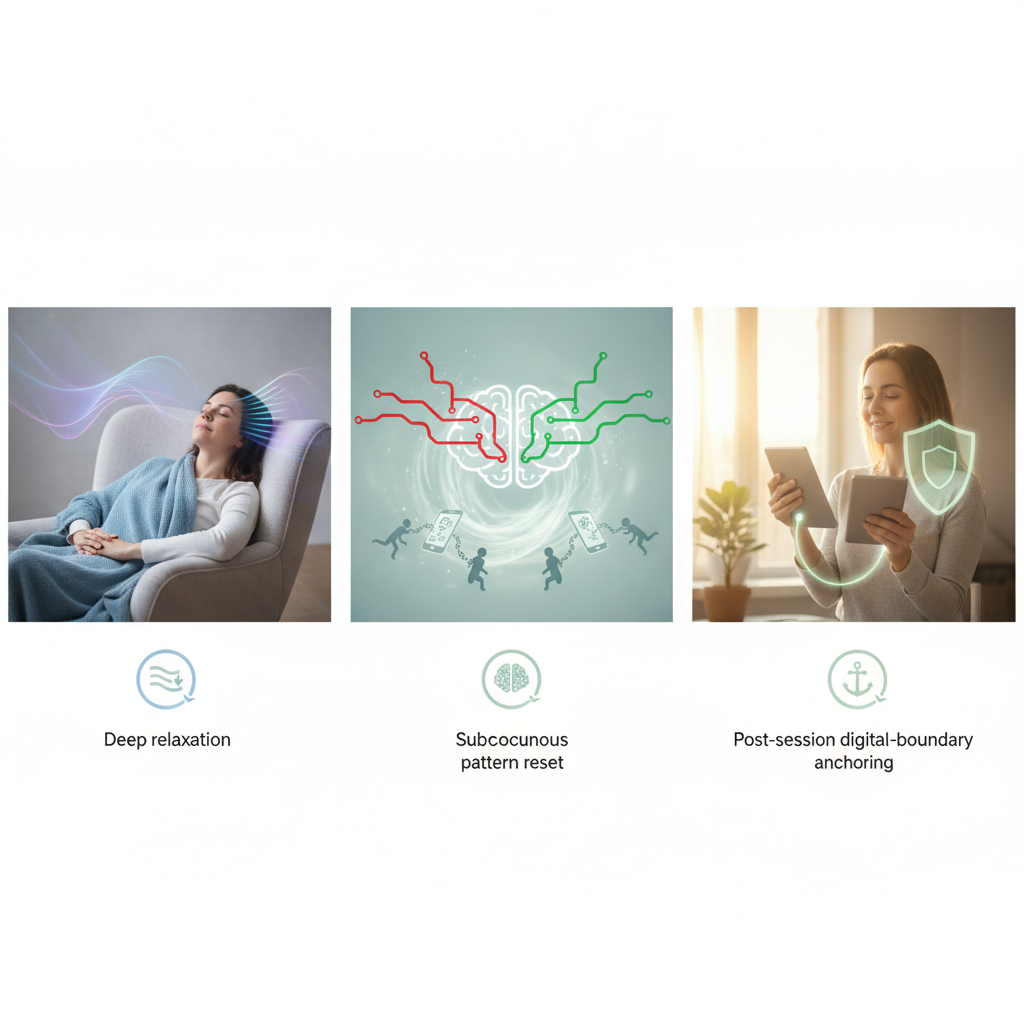
Sessions combine guided relaxation to downshift sympathetic arousal, subconscious reframing to change the meaning of alerts, and a simple physical anchor you practice until calm is automatic. That mix reduces Anxiety spikes, shortens Burnout cycles, and restores focus at work and outside it.
Hypnosis works quickly because it targets the automatic, habitual part of your brain that reacts before you decide.
What Is Tech‑Related Stress, Scientifically?
Persistent connectivity triggers the brain’s threat circuitry and elevates cortisol and adrenaline. The APA – Technology Use and Mental Health finds people who spend over 6 hours a day on screens report about 2.5 times higher Anxiety than those who limit to 3 hours. The NIH – Impact of Screen Time on Anxiety and Burnout shows prolonged screen time raises sympathetic tone and fragments sleep, which accelerates Burnout.
Chronic screen exposure creates a physiological loop: alerts raise arousal, arousal disrupts sleep, poor sleep amplifies reactivity.
Three Core Triggers of Digital Burnout
- Notification overload: 1,200 alerts per day on average.
- Multitasking fatigue: 25% drop in task accuracy after 5 consecutive switches.
- Sleep disruption: 40% of Tech users report difficulty falling asleep after late‑night scrolling.
Why Hypnotherapy Beats Generic Relaxation Apps
Guided-breathing apps can lower heart rate in the moment. They rarely change the belief system that primes you to check every ping. Hypnotherapy reframes the cue‑response loop itself, so your body no longer leaps into fight-or-flight at a vibration. We blend Emotional Freedom Technique (EFT) tapping with hypnotic suggestion to anchor a new default reaction.
Instead of calming you once, Hypnotherapy retrains your automatic reaction so calm becomes the new default.
Step‑by‑Step Process: 5‑Phase Tech Anxiety Hypnotherapy
Phase 1 – Pre‑Session Screening (5 min)
We use a 10‑point Anxiety scale (1 = calm, 10 = frantic). Scores above 7 get a brief grounding before the main induction.
Phase 2 – Deep Relaxation Induction (10 min)
Progressive muscle relaxation, breathing at ~6 breaths per minute, and a calming visual (a still lake) aim to reduce heart rate below 60 bpm; you can check this with a simple pulse read.
Phase 3 – Subconscious Reframing (15 min)
Guided imagery rewrites the notification cue into something neutral or curious: “When my phone rings, I feel curious, not pressured.” We repeat the phrase several times while layering positive outcomes.
Phase 4 – Post‑Session Self‑Anchor (5 min)
We create a discreet tactile anchor (a subtle wrist tap) to cue the calm state. Practice it for 3 days, pairing it with a controlled phone buzz until it triggers automatically.
Phase 5 – Follow‑Up Check‑In (5 min each week for 4 weeks)
Weekly reviews track Anxiety scores and refine the anchor. If your score drops below 4 and alerts no longer spike cortisol, we mark the protocol effective.
The concrete 5‑phase framework turns the phone from a threat into a neutral tool.
Case Snapshot: Emily’s 3‑Week Turnaround
Emily, 32 and a software engineer, averaged 8 hours of screen time daily. After three sessions her pre‑session Anxiety dropped from 8 to 4 and she shifted sleep onset earlier by about 30 minutes. The wrist anchor cut her daily check‑in time from 45 minutes to 10 minutes, letting her focus work blocks stay intact.
Targeted sessions plus home practice produced measurable sleep and attention gains within weeks.
Comparing Tech Anxiety Hypnotherapy with CBT and Mindfulness Apps
| Method | Focus | Strength | Limitations |
|---|---|---|---|
| Tech Anxiety Hypnotherapy | Subconscious re‑programming | Fast, lasting change | Requires trained therapist |
| CBT | Thought patterns | Evidence‑based, flexible | Less immediate symptom relief |
| Mindfulness Apps | Present‑moment awareness | Accessible anytime | Often generic guidance |
Hypnotherapy often complements CBT and apps by closing the gap between intention and automatic reaction.
Daily Digital Well‑Being Toolkit
Pair Hypnotherapy gains with simple, measurable habits.
- Schedule two‑hour screen breaks every four hours.
- Use “Do Not Disturb” for the first 30 minutes after waking.
- Wind down nightly: dim lights and read a physical book.
- Track screen time with built‑in OS tools; aim to cut 30 minutes per week.
- Practice the self‑anchor when your phone buzzes and note heart‑rate shifts.
Small, repeatable habits preserve the physiological gains you get in sessions.
How to Start: Book Your Free 30‑Minute Consultation

If you want to replace digital overwhelm with predictable calm, Contact – Schedule Your Free Consultation. The first 30 minutes pinpoints your main triggers and outlines a tailored Hypnotherapy plan.
The consult clarifies whether you need a short course or a longer plan and sets measurable goals.
Frequently Asked Questions
- What is the difference between Hypnotherapy and relaxation apps?
- Hypnotherapy engages the subconscious to re‑frame beliefs, while apps mainly lower heart rate through guided breathing.
- How long does the benefit last?
- With regular practice and the self‑anchor, most clients report lasting calm for at least 6 months.
- Can I do Hypnotherapy on my own?
- Self‑hypnosis is possible, but guided sessions with a trained practitioner provide the most reliable results.
- Is it safe for people with PTSD?
- Yes, but the practitioner will adjust the protocol to ensure comfort and safety.
- How often do I need follow‑ups?
- Weekly check‑ins for the first month, then monthly until the score stays below 4.
These FAQs summarize typical timelines and safety considerations clients ask about first.
Science and Studies: Evidence Behind Hypnotherapy for Tech Anxiety
Clinical evidence supports hypnosis and related interventions for reducing Anxiety and stress responses. Attention‑interruption work at UC Irvine (Mark et al.) showed knowledge workers face interruptions roughly every 11 minutes and need about 23 minutes to return to the original task — a clear productivity and stress cost. Smartphone studies report frequent checks (commonly 80–100 per day), which connects repetitive checking to acute stress responses.
Systematic reviews and meta‑analyses of clinical hypnosis for Anxiety disorders report meaningful reductions in self‑reported Anxiety versus controls, and many trials show faster symptom relief than behavioural approaches alone. Combining Hypnotherapy with behavioural techniques (EFT, scheduling, stimulus control) tends to strengthen effects because the intervention tackles both physiological arousal and learned cue‑response cycles.
Hypnotherapy isn’t a magic pill, but clinical literature supports it as a powerful adjunct to behavioural changes for lowering autonomic hyperarousal tied to heavy device use.
Deeper Examples: Scripts and Anchors You Can Use
Try these between sessions to speed consolidation.
Short Induction (1–2 minutes)
“Find a comfortable seat. Close your eyes. Take a slow breath in for four, hold for two, and out for six. Notice the weight of your feet. With every exhale allow your shoulders to soften. Imagine a warm, golden light at the top of your head slowly washing down, relaxing each muscle. As you breathe, feel a natural calm settling into your chest. When you hear a phone tone now, you’ll allow curiosity to arise and let urgency pass.”
Subconscious Reframe Phrases (repeat aloud or silently 7 times)
- “A notification is information, not an emergency.”
- “I choose which alerts need my attention.”
- “When my phone buzzes, I breathe and decide.”
Anchor Pairing Protocol
- Enter a relaxed state (use the short induction above).
- Apply a discreet wrist tap (or press your thumb to your index finger) and say the reframe phrase once.
- Repeat the tap + phrase 5–7 times across several short practices.
- Over the next 48–72 hours, deliberately pair the wrist tap with a controlled phone buzz (silence it and vibrate once) until the calm response becomes automatic.
These small, repeatable actions strengthen neural pathways so the calmer response surfaces quickly in daily life.
Regular, brief practice makes the anchor dependable when you need it most.
Additional Case Studies: Raj and Lena
Raj, 45, led a remote team and was reactive to Slack pings, checking every 10 minutes. After four Hypnotherapy sessions plus scheduled focus blocks, he reduced Slack checks to three predictable moments per day. Objective result: faster task completion and a 60% drop in perceived weekly work stress.
Lena, 24, manages social media and suffered late‑night scrolling. Two targeted sessions on stimulus control and sleep re‑anchoring moved her last screen time 45 minutes earlier and cut sleep latency from 40 minutes to 18. Her daytime energy and creativity rose as a result.
Short, focused programs produced concrete behavioral and sleep gains across these cases.
Risks, Contraindications and When to Refer
Hypnotherapy is generally safe but not appropriate for everyone. Exercise caution or refer when you see:
- Active, untreated psychosis or severe dissociative disorders — refer to a psychiatrist first.
- Severe uncontrolled epilepsy — consult a neurologist.
- History of complex trauma — use clinicians trained in trauma‑informed hypnosis.
Always disclose medical and psychiatric history so clinicians can tailor protocols safely.
Screening and clear disclosure keep Hypnotherapy safe and effective for most clients.
Expanded FAQ
- Will Hypnotherapy erase my memory of notifications?
- No. Hypnotherapy changes the emotional and physiological response to notifications; it does not erase memories or stop you from receiving alerts.
- How much does a typical program cost?
- Costs vary by clinician and region. Many programs run 3–6 sessions; some practices offer sliding scale options or package pricing. The free 30‑minute consult helps clarify your plan and costs.
- Can children and teens benefit?
- Yes. Age‑appropriate Hypnotherapy can help teens with compulsive phone use; always involve caregivers and use clinicians experienced with younger clients.
- How quickly will I notice changes?
- Some clients notice reduced heart rate and less urge to check within a single session; stable habit change typically requires 2–4 sessions plus home practice.
Most clients see initial physiological shifts fast; lasting habit change needs short-term follow-up and practice.