

Quick Answer: In the debate over Hypnosis vs Medication Anxiety care, drugs adjust neurotransmitters quickly to dull physical distress, while clinical hypnotherapy retrains subconscious threat triggers to build lasting autonomic control without chemical side effects or tolerance.
Chronic Anxiety drains your battery before the day even starts. Your chest feels tight, your thoughts race through catastrophe scenarios, and your nervous system stays stuck in emergency mode. When deciding how to treat it, most people weigh daily prescription pharmaceuticals against targeted clinical hypnotherapy.
Both methods aim to calm an overstimulated nervous system, but they take fundamentally different routes. Making the right choice comes down to how each approach changes brain chemistry, subconscious programming, and long-term coping capacity.
Hypnosis vs Medication Anxiety: Core Differences and Mechanisms
Prescription drugs work from the outside in. Hypnotherapy works from the inside out.
The National Institute of Mental Health overview on GAD outlines how Generalized Anxiety creates relentless, disproportionate worry that disrupts basic daily functioning. Conventional care usually starts with a written prescription.
Pharmaceuticals target neurotransmitter pathways directly. SSRIs boost available serotonin over time, while benzodiazepines stimulate GABA receptors to slow central nervous system firing. They suppress the physical tremors, racing pulse, and panic spikes on a purely biochemical level.
Hypnotherapy approaches the problem differently. A practitioner guides your brain into an alpha-theta state where your nervous system drops its guard. In this focused trance, you pinpoint root emotional triggers, interrupt automatic fight-or-flight loops, and anchor physical calming responses you can trigger at will.
While Medication changes neurotransmitter levels temporarily, hypnotherapy retrains the subconscious mind to stop firing false alarms in the first place.
How Does Hypnotherapy for GAD Work Compared to Pharmaceuticals?
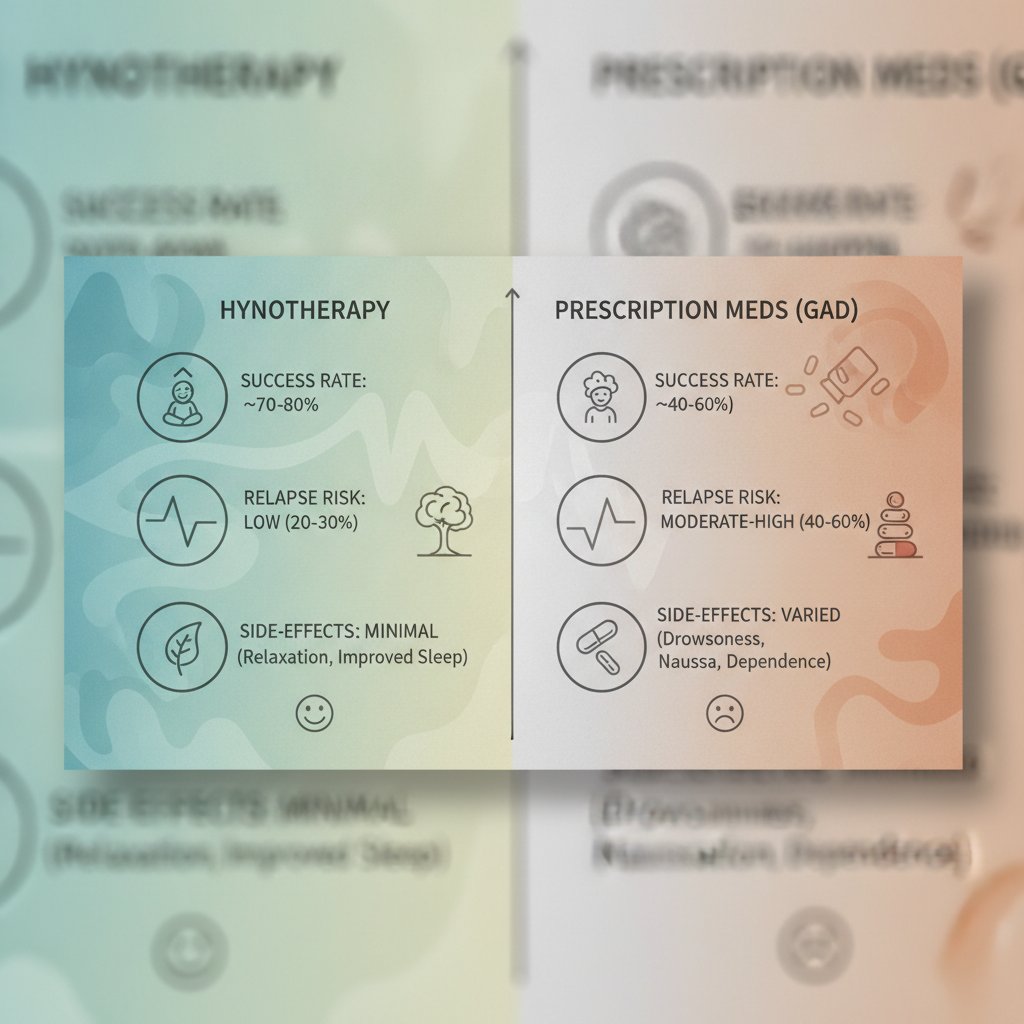
Think of prescription Medication as a chemical shock absorber. When you take an SSRI or a beta-blocker, active molecules flood your system to alter receptor activity. The FDA drug evaluation standards test these compounds specifically for short-to-medium-term symptom reduction across clinical trials.
Medication cannot untangle thought patterns or dissolve conditioned panic responses. Stop the pills, and the original baseline Anxiety almost always returns.
Hypnotherapy uses neuroplasticity instead. By bypassing conscious analytical filters, you communicate directly with your autonomic nervous system. Somatic reframing, regression techniques, and post-hypnotic anchors teach your brain that ordinary stressors are not life-threatening emergencies.
Comparing the Core Treatment Pillars
- Speed: Benzodiazepines act within 30 minutes; SSRIs take 4 to 8 weeks. Hypnotherapy shifts nervous system reactions within the first 1 to 3 sessions.
- Root Resolution: Medications quiet symptoms while active. Hypnotherapy disarms the subconscious memory associations keeping you on edge.
- Dependency Risk: Pharmaceuticals carry real risks of physiological tolerance and rough withdrawal periods. Hypnotherapy creates zero chemical dependence.
- Skill Building: Hypnotherapy teaches self-induction protocols you keep and use for the rest of your life.
Clinical hypnotherapy equips you with autonomous self-soothing tools rather than leaving you reliant on a daily refill schedule.
Comparing Side Effects, Costs, and Long-Term Outcomes
Look past immediate relief when evaluating your options. Long-term costs, physical toll, and lifestyle friction matter just as much.
| Evaluation Metric | Prescription Medication | Clinical Hypnotherapy |
|---|---|---|
| Common Side Effects | Nausea, weight gain, insomnia, sexual dysfunction, emotional blunting, withdrawal symptoms. | Deep physical relaxation, mental clarity, occasional brief emotional processing fatigue. |
| Treatment Duration | Ongoing (often years or indefinite maintenance). | Structured series (typically 4 to 8 focused sessions). |
| Financial Investment | Recurring monthly co-pays, doctor visits, and lab monitoring over years. | One-time investment for a defined program with permanent skill retention. |
| Long-Term Relapse Rate | High upon discontinuation if coping mechanisms are absent. | Low, as neural pathways are systematically rewired for emotional resilience. |
Side effects derail many patients. People taking anti-Anxiety meds frequently describe feeling emotionally flat, disconnected, or fatigued. These complaints lead nearly half of psychiatric patients to stop their Medication prematurely.
Hypnotherapy produces the opposite ripple effect. Clients regularly report deeper sleep, clearer focus, calmer digestion, and an immediate sense of personal agency.
Hypnotherapy delivers a clean safety profile because it works directly with your brain’s existing neurochemistry rather than introducing foreign compounds.
The 4-Step Clinical Protocol for Overcoming Anxiety Without Reliance on Pills

At HolisticHypno Healing, we follow a systematic subconscious recalibration protocol. If you want sustainable relief without perpetual Medication, here is how we structure the process:
- Autonomic Baseline Calibration: We map your somatic Anxiety blueprint, identifying whether your system runs toward hyper-arousal (palpitations, sudden panic) or hypo-arousal (numbness, executive paralysis).
- Subconscious Trigger Desensitization: In deep somnambulistic trance, we locate early emotional imprints that drive your vigilance and neutralize their somatic charge.
- Neural Pathway Reframing: We install somatic interrupting cues, such as targeted physical anchors, that halt rising Anxiety before it cascades into a full episode.
- Self-Hypnosis Integration: We train you in rapid self-induction techniques to tone your vagus nerve on demand, giving you full independence.
Our dedicated clinical Anxiety hypnotherapy programs target the somatic roots of panic, phobias, and chronic nervous system dysregulation.
A structured hypnotherapy protocol shifts the nervous system out of survival mode and embeds lasting emotional resilience.
Can You Combine Hypnotherapy with Prescription Anxiety Medication?
Yes. Hypnotherapy pairs safely with anti-Anxiety medications because it involves zero pharmacological interactions.
Many of our clients start hypnotherapy while on an SSRI or a beta-blocker. Medication provides a stable floor during severe distress, which makes focused trance work easier to access. As subconscious restructuring takes hold, baseline Anxiety steadily drops.
If your goal is tapering off Medication, hypnotherapy builds the emotional regulation skills you need for that step. Coordinate any dosage adjustments directly with your prescribing doctor.
Combining therapies allows clients to build internal self-regulation tools while maintaining medical stability under physician supervision.
Ready to Break Free from Chronic Anxiety?
You do not have to live in survival mode or depend on daily prescriptions indefinitely. Clinical hypnotherapy helps you regain calm, clarity, and control.
Frequently Asked Questions
How many Hypnosis sessions are needed for Generalized Anxiety Disorder?
Most clients see substantial shifts within 4 to 8 focused sessions. Because hypnotherapy works directly with subconscious triggers, progress happens significantly faster than with standard talk therapy.
Will I lose control or reveal private secrets during an Anxiety Hypnosis session?
No. Hypnosis is simply a state of heightened focus. You stay aware of your environment the entire time, hear everything being said, and maintain complete control over what you say and do.
Can hypnotherapy permanently cure Generalized Anxiety Disorder?
Hypnotherapy neutralizes the subconscious associations and somatic loops driving your Anxiety. By rewiring how your brain responds to everyday triggers, it provides durable, long-term resilience.
What should I do if I am already taking Anxiety Medication?
Stay on your current Medication and begin hypnotherapy as planned. Never change your psychiatric dosage on your own. Once your self-regulation tools are firmly established, work with your prescribing physician on a safe tapering schedule if that is your goal.