


Financial Stress Hypnotherapy for San Jose Professionals
Quick Answer: Financial Stress Hypnotherapy can reduce money-related anxiety for busy San Jose Professionals Through targeted subconscious re-patterning, calming nervous-system techniques, and adjunct EFT tapping, delivered in short Practical sessions you can do online or in person. This approach is non-pharmaceutical and complements work-based coping strategies, and it’s designed to fit into a packed week without adding unnecessary complexity.
Financial Stress Hypnotherapy: how it helps San Jose Professionals
San Jose Professionals face steep housing costs, fast-moving markets, and persistent job uncertainty. We move you from acute money anxiety into steady, actionable habits by working with the nervous system and the subconscious beliefs that drive avoidance, impulsive choices, and sleepless nights. Hypnotherapy targets the learned responses that keep you stuck, not the symptoms alone.
How do Hypnotherapy and EFT work on money anxiety?
Answer: They change habit-level responses and down-regulate threat circuitry quickly.
Detail: Hypnotherapy uses focused relaxation and suggestion to reach the parts of your mind that store automatic reactions to Financial cues — paychecks, bills, market dips. EFT (Emotional Freedom Techniques or tapping) involves gentle fingertip stimulation of acupressure points while you name a distressing money thought, which lowers arousal and makes new learning stick. Combined, EFT calms the nervous system and Hypnotherapy embeds calmer, more Practical scripts.
Context: This blend fits Professionals who need time-efficient tools and prefer a non-medication route.
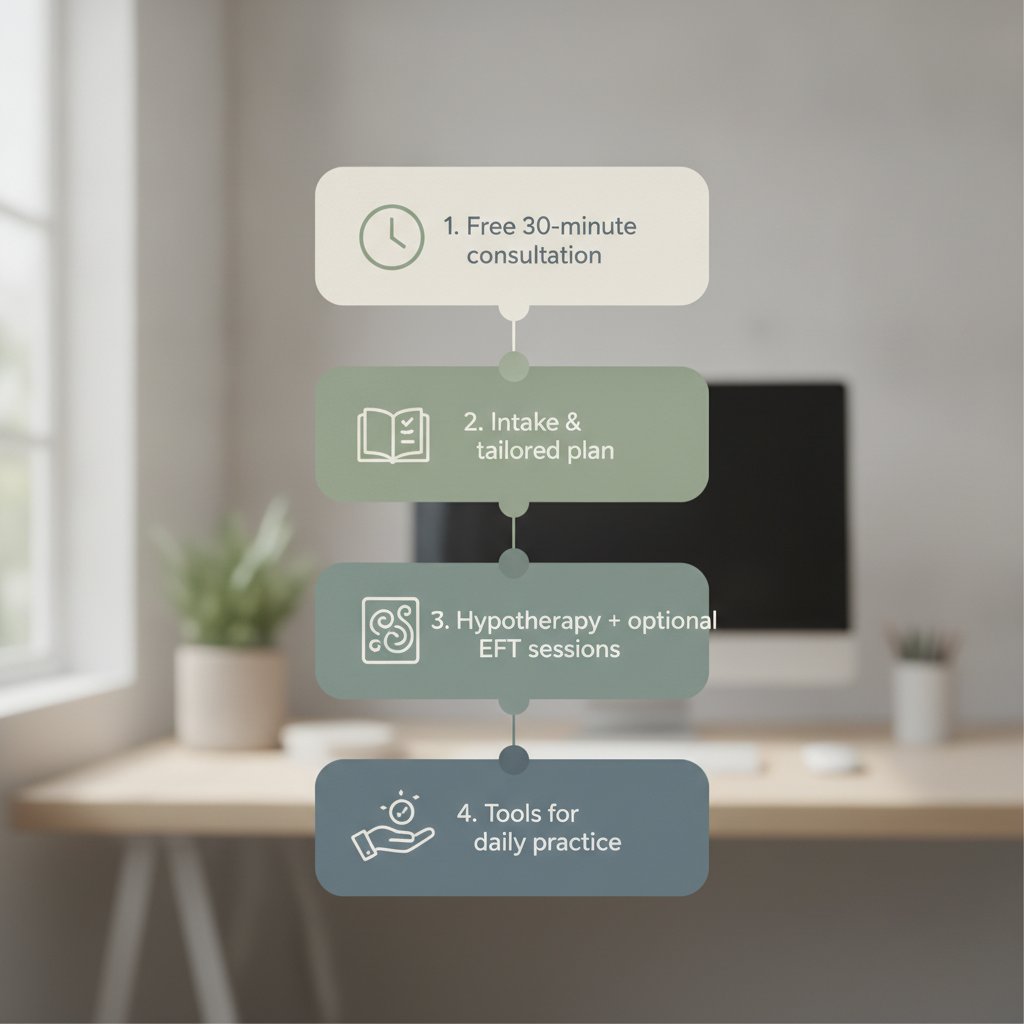
What does a client journey look like at HolisticHypno Healing?
Answer: Clear, scheduled steps from a free consult to tailored sessions and daily micro-practices.
Detail: Our pathway is structured and measurable so you see real progress. We start with a free 30-minute breakthrough consultation, then move to an intake and weekly sessions tailored to your goals.
- Free 30-minute breakthrough call with Merve. You can Schedule your free 30-minute breakthrough consultation with Merve to describe your main money triggers and current coping strategies.
- Intake & goal-setting (60 minutes): baseline client history, SUDS (0–10) ratings for specific triggers, sleep and decision-making impact, and a commitment plan.
- Tailored sessions: weekly 60-minute Hypnotherapy plus 10–15 minutes of EFT integration for 4–8 sessions depending on goals.
- Between-session tools: self-hypnosis recordings (7–10 minutes), a daily EFT micro-routine (3–5 minutes), and short breathing exercises designed for workdays.
- Review session: after 4 sessions we compare SUDS ratings and functional markers (sleep, ability to open bills, decision latency). If progress is under target, we adjust the protocol.
Context: For more on session structure and progress tracking, see How Hypnotherapy sessions and the client journey work. Also view our Hypnotherapy & EFT services at Holistic Hypno Healing for specifics.
Step-by-step practitioner protocol (exact settings and decision criteria)
Answer: A Practical six-step protocol you can expect, with thresholds that guide adjustments.
- Initial SUDS mapping: rate 3–6 trigger scenarios on a 0–10 scale. If baseline SUDS average is ≥6, schedule weekly sessions; if ≤5, consider biweekly maintenance sessions.
- Session structure (60 minutes): 10-minute check-in, 15-minute EFT tapping rounds (three rounds per trigger), 25-minute guided Hypnotherapy script, and a 10-minute debrief with a self-hypnosis assignment.
- EFT specifics: standard tapping points, three rounds per trigger, rate SUDS after each round. If SUDS drops ≥2 points within a session, proceed to hypnotic reinforcement.
- Self-hypnosis assignment: 7–10 minute audio, daily before bed or first thing in the morning, repeating a concise behavioral script (sample provided in sessions).
- Progress check: after four sessions, expect a 2–3 point average SUDS reduction; if not achieved, we either lengthen sessions to 75 minutes or introduce imagery-based desensitization.
- Exit criteria: client reports fewer intrusion episodes, measurable sleep improvement, and greater functional engagement (for example, opening correspondence or attending budgeting meetings) over six to eight sessions.
We use SUDS drops and real-world function as the decision metric, not arbitrary session counts.
Practical daily micro-practices for San Jose workdays
Answer: Short, repeatable actions you can do between meetings to reduce money anxiety.
- Two-minute baseline breath: 4-6-8 breathing (inhale 4s, hold 6s, exhale 8s) before opening email or Slack.
- Quick EFT check: three rounds of tapping on the eyebrow and collarbone points while stating a brief set-up phrase (for example, “Even though I feel anxious about this bill, I accept myself”). Keep it to 90–120 seconds.
- Self-hypnosis pause: a 7-minute audio after work to shift from reactive mode to planning mode.
- Decision micro-habit: when a Financial choice comes up, delay for 24 hours if non-urgent and perform one EFT round to reduce impulsivity.
Micro-practices are short because busy Professionals actually do short practices.
Comparison: Hypnotherapy + EFT versus CBT or medication for money anxiety
| Method | How it works | Typical sessions | Pros | Cons |
|---|---|---|---|---|
| Hypnotherapy + EFT | Alters automatic responses, down-regulates arousal, embeds new scripts | 4–8 sessions plus daily 7–10 minute practice | Non-pharmaceutical, fast calming, Practical tools | Requires daily practice, variable insurance coverage |
| CBT (Cognitive Behavioral Therapy) | Reframes thoughts and builds behavioral experiments | 8–12 sessions | Strong evidence base for anxiety, structured approach | Can be slower for deep-seated automatic responses |
| Medication (anxiolytics/antidepressants) | Alters brain chemistry to reduce symptoms | Ongoing management, prescriber required | Fast symptom Relief for severe anxiety | Side effects, does not teach coping mechanics |
Short composite case study: a San Jose product manager

Answer: A six-session pathway shows how focused work changes behavior.
Detail: A composite client who reported SUDS 8 when checking investments followed the protocol above. After an intake and four weekly sessions combining EFT and hypnosis, their SUDS for investment checks dropped to 4. They used the 7-minute nightly self-hypnosis every day and the 4-6-8 breath before opening Financial apps. Functionally, they spent less time ruminating and more time planning, scheduling monthly budget reviews instead of avoiding them. Short, consistent practice produced behavioral changes faster than occasional worry-focused conversations.
Context: This is a composite example reflecting typical practice patterns at HolisticHypno Healing rather than a single client story.
What should I expect in a Hypnotherapy session for Financial worries?
Answer: Relaxed, goal-directed work with measurable homework and clear progress points.
Detail: Expect a brief check-in, EFT rounds, a guided trance with tailored suggestions, and a short homework assignment. We measure progress using SUDS and functional outcomes. The sessions feel calm and Practical, not mystical.
Safety, contraindications, and realistic expectations
Answer: Hypnotherapy and EFT are low-risk but they aren’t a replacement for psychiatric care when symptoms are severe.
Detail: We screen for severe mood disorders, recent trauma, or unmanaged substance use and refer to medical care when needed. If your anxiety includes suicidal ideation or severe dissociation, urgent psychiatric support is the priority. For general Stress, the CDC — Coping with Stress offers Practical guidance on managing acute Stress, and the American Psychological Association — Stress overview provides additional background on Stress impacts.
We combine safety screening with measurable progress checks to ensure therapy stays appropriate and effective.
Frequently Asked Questions
Does Hypnotherapy really change money beliefs?
Yes. By repeating calm, specific behavioral scripts in a relaxed state, Hypnotherapy weakens automatic threat responses and replaces them with Practical decision habits.
Can I do this entirely online from San Jose?
Yes — many clients do online sessions for convenience. We deliver full protocols remotely, including audio self-hypnosis files and guided EFT coaching.
How long before I notice results?
Many people feel lower arousal after the first EFT and Hypnotherapy session; measurable functional changes typically appear within 4–8 weekly sessions when you follow daily micro-practices.
Is EFT the same as acupuncture?
No. EFT uses fingertip tapping on acupressure points while you voice the issue; it’s non-invasive and done without needles.
How do I start?
Begin with a free consult. Schedule your free 30-minute breakthrough consultation with Merve to see if we’re a fit, and review available in-person and online options.
Next steps and clear call to action
We recommend you book the free 30-minute breakthrough call if money anxiety is undermining decisions, sleep, or performance. That call maps your triggers, sets a short SUDS baseline, and outlines the 4–8 session plan tailored to your schedule. Book now to get a Practical plan rather than another to-do list.
Start by reviewing our offerings here: Hypnotherapy & EFT services at Holistic Hypno Healing. When you’re ready, Schedule your free 30-minute breakthrough consultation with Merve.