

Driving Phobia Hypnotherapy: Recover Confidence After a Crash
Driving phobia hypnotherapy helps many people regain confidence after a crash by addressing subconscious fear networks rather than only conscious avoidance. Quick answer: focused hypnotherapy combined with graduated in-session exposure and practical coping tools typically reduces avoidance, lowers panic symptoms, and speeds return to driving within several weeks to months when paired with a structured pathway.
Relatable story: stuck at the curb after a collision
You know the scene: a fender-bender at a stoplight, glass cleared, insurance exchanged, yet you can’t get back into the driver’s seat. You loop the crash in your head. Your hands tremble. Simple trips feel impossible. That hesitation is more than worry; it’s a conditioned fear response anchored in the nervous system.
If the memory of a crash makes you avoid driving, that avoidance reinforces the fear; targeted hypnotherapy breaks that cycle.
How driving phobia hypnotherapy reaches subconscious fear
Hypnotherapy doesn’t erase memories. It changes how your brain and body respond to them. Under guided trance we access the sensory and emotional associations that sit beneath conscious thought and reframe the threat response so the body stops escalating toward panic at triggers like brake screeches or the smell of burnt metal.
Clinical sources describe driving phobia as situational avoidance that often overlaps with broader anxiety and trauma responses; see the Wikipedia entry on driving phobia (agoraphobia related) for a concise overview and symptom list.
Hypnosis pairs direct subconscious suggestion with graduated exposure so learned fear patterns extinguish while new, calm responses are rehearsed.
What does a focused treatment pathway look like?
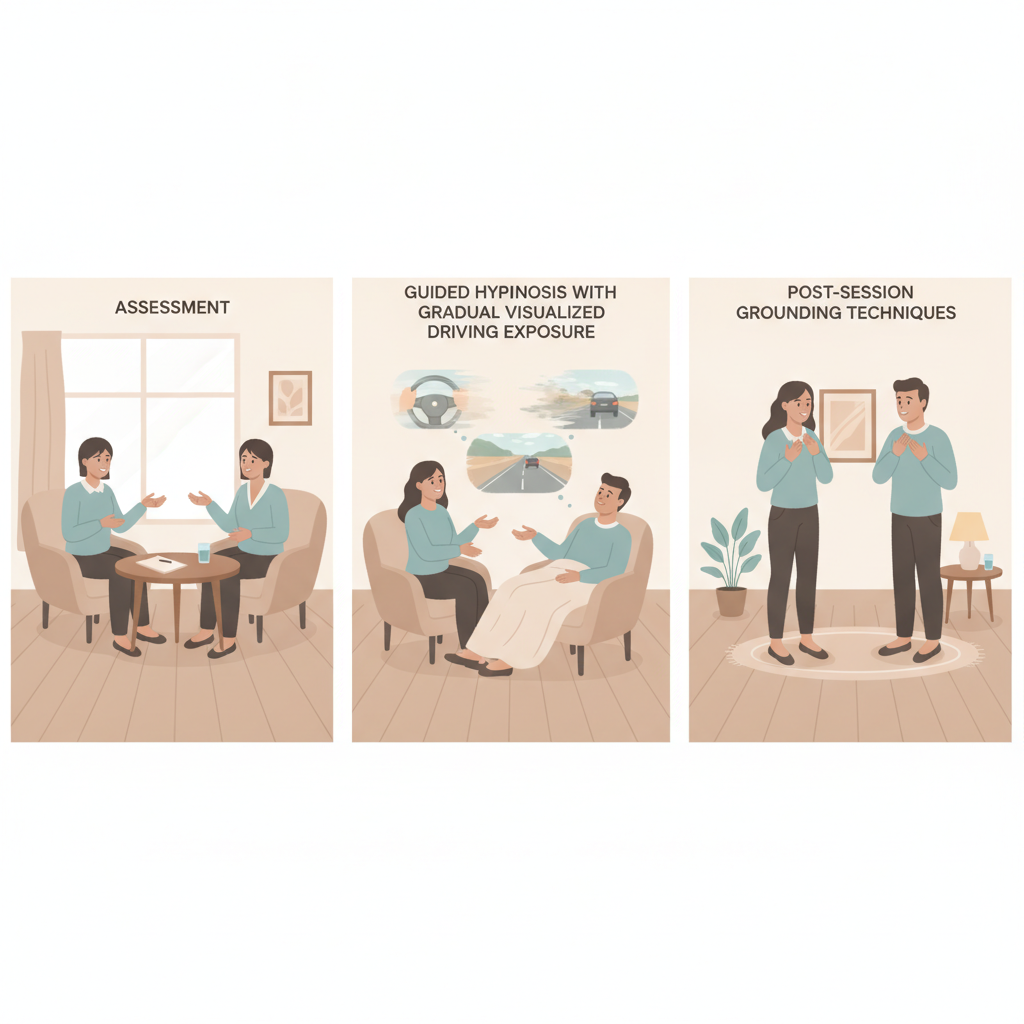
We use a defined three-step process at HolisticHypno Healing that blends assessment, trance work with exposure, and practical aftercare.
- Pre-session assessment (30–45 minutes). Intake covers crash details, current avoidance behaviours, panic symptoms, medication status, and any PTSD indicators. We assess symptom severity using a 0–10 SUDS (Subjective Units of Distress Scale) for driving triggers and screen for PTSD signs that May need referral; see NIMH information on PTSD and trauma-related anxiety. Decision rule: if flashbacks or hyperarousal score above 7/10 and have lasted longer than one month, we coordinate care with a clinician experienced in trauma before proceeding to prolonged in-vivo exposure.
- Guided hypnosis + staged exposure (60–90 minutes). Typical session structure: 10–15 minutes induction (progressive relaxation or eye-fixation technique), 30–45 minutes of target-work combining imaginal exposure and hypnotic suggestion, 10–15 minutes of rehearsal and reorientation. Exposure ladder uses SUDS anchors: start at items rated 1–3 (for example, picturing the route) and advance when the client reports a sustained 40% drop in SUDS for that item across two rehearsals. In-session criteria to progress to the next ladder rung are SUDS ≤ 3 and calm physiological signs such as slower breathing and relaxed hands for two consecutive rehearsals.
- Post-session coping tools and homework. Scripts for self-hypnosis (10–12 minute audio), a 7-item breathing protocol (4-6-8 count), and a graded exposure checklist for between-sessions practice. Homework example: practice imaginal exposure at level 2 three times daily for five days; only move to level 3 after meeting the SUDS rule above. If avoidance increases or panic intensifies, pause progression and revisit the prior step in the next session.
Following these steps gives you measurable decision points and clear thresholds so progress isn’t guesswork.
How many sessions will you need, and what trade-offs matter?
Most clients see a meaningful drop in avoidance within 4–8 sessions. Restoring full confidence can take longer, depending on crash severity and any pre-existing anxiety. You can push pace to speed habituation, but that risks symptom flare-ups. Slow pacing feels safer, but it prolongs avoidance. We choose pace based on the SUDS progression rule and how stable you are between sessions.
We favor steady, measurable progress over rapid escalation because it yields more durable gains and fewer relapses.
Can hypnotherapy exposure replace in-car exposure therapy?
Short answer: hypnotherapy exposure can complement and, for some people, substitute early in‑car exposure, but it’s not an automatic replacement. For clients whose panic prevents any car entry, imaginal and hypnotic exposure builds a calm baseline before introducing real-world driving. For people who can physically drive but still panic, short supervised drives—either with a therapist or a trusted support person—are the faster way to generalize gains.
We match the method to your starting point: hypnosis-first when in-car exposure is impossible, or combined when you can tolerate short supervised drives.
Common mistakes practitioners and clients make — and what we do instead
- Rushing exposure before physiological regulation — do breathing and self-hypnosis first.
- Using only conscious reassurance — integrate subconscious reframing so the body stops reacting automatically.
- Failing to set measurable progress rules — use SUDS thresholds (40% sustained reduction) to decide when to advance.
We avoid vague goals by setting specific SUDS, rehearsal counts, and stability criteria before progressing.
Side-by-side: hypnotherapy exposure vs. standard exposure therapy

| Feature | Hypnotherapy with exposure | Standard CBT/Exposure |
|---|---|---|
| Where exposure begins | Imaginal and hypnotic rehearsal; moves to in‑car once calm baseline set | Typically in‑vivo from the start under therapist supervision |
| Physiological regulation | Built into trance and self-hypnosis practice | Breathing and grounding taught, but not always rehearsed under trance |
| Typical timeline | 4–10 sessions depending on severity | 6–12 sessions commonly |
| Best for | Clients who need physiological down‑regulation before real‑world exposure | Clients able to do in‑vivo practice early |
Each approach works; we pick the one that fits your starting capacity and safety needs.
Client testimonials (anonymized composites)
Composite excerpt 1: “After two sessions I could picture the road without my chest tightening. By session five I drove around the block.”
Composite excerpt 2: “Self-hypnosis scripts gave me a reliable tool for the moments I felt triggered. I used them every morning and before short drives.”
These composites reflect typical patterns we see at HolisticHypno Healing: early reduction in intrusive fear and steady rebuilding of driving habits.
How to know when to seek combined care with a trauma specialist
If you have vivid flashbacks, intrusive images of the crash, severe hypervigilance, or functional impairment beyond driving, we consult with trauma-focused clinicians. The NIMH information on PTSD and trauma-related anxiety offers guidance on symptoms that require specialized care. At HolisticHypno Healing we coordinate referrals when the trauma burden exceeds the scope of short-term hypnotherapy alone.
We will pause exposure work and connect you to trauma care if PTSD-style symptoms score high or if distress increases after initial sessions.
Frequently Asked Questions
Will hypnotherapy make me forget the accident?
No. Hypnotherapy changes the emotional charge and automatic bodily response to the memory so it stops triggering panic.
How quickly will I be able to drive again after a session?
Many people regain short-trip tolerance within 2–6 sessions; progress depends on your baseline SUDS levels and homework compliance.
Is hypnotherapy safe after a serious crash?
Yes, when paired or coordinated with trauma-informed care as needed. We screen for PTSD signs and refer when indicated.
Do you offer other services that can help?
Yes. See our full Hypnotherapy Services Overview for stress, anxiety, fear and phobias, and how those services integrate with targeted driving work.
Ready to take the first step?
If this describes you, book a free 30-minute consultation with Merve to review your crash history, run a SUDS screen, and map a low-risk pathway back to driving. Meet Merve, Certified Hypnotherapist and schedule your consult—no pressure, only a clear plan.
Book a free 30-minute consultation to get a written, step-by-step plan for returning to driving safely.